


← Klartext Business
Trade-Show Give-aways in the Cost-per-Lead Check: What a Contact Really Costs
Updated SilentLink-Team ≈ 3 min read
Key points
- The cost-per-lead of classic scatter items isn't so much high as incalculable: without a return channel there's no figure you could set against the budget. Division by zero.
- As soon as a promotional item gets activated, that reverses: quantity, activations and contacts are countable, and the give-away budget gets its own line in the reporting for the first time.
- The honest arithmetic works with open assumptions instead of promised rates — and doesn't blindly compare the value of a trade-show lead (qualified, with a personal contact moment) to that of a click lead.
After the trade show comes the reckoning, and it’s uncomfortable for every channel — but for only one is it impossible. The show’s advertising campaign delivers its numbers free of charge: impressions, clicks, cost per lead. The stand delivers scanned visitor badges. And the two thousand give-aways that went over the counter? Deliver a gut feeling.
The problem isn’t that the cost-per-lead of scatter items is too high. The problem is that it doesn’t exist: cost divided by zero attributable contacts is not a metric, but a blank. And in the budget meeting, the blank always loses — to any channel that can show some figure, even a mediocre one.
Why the category figures don’t help
The promotional-products industry pushes back, with genuinely solid studies: according to the 2019 GWW impact study, around 90 percent of promotional items are taken and used, and around 70 percent of recipients recall the advertising brand. Why these figures still don’t defend a budget, we’ve described in detail elsewhere — the short version: they measure the category, not your campaign. That promotional items work on average doesn’t answer the only question the finance team asks: What did ours get us?
The arithmetic, once a return channel exists
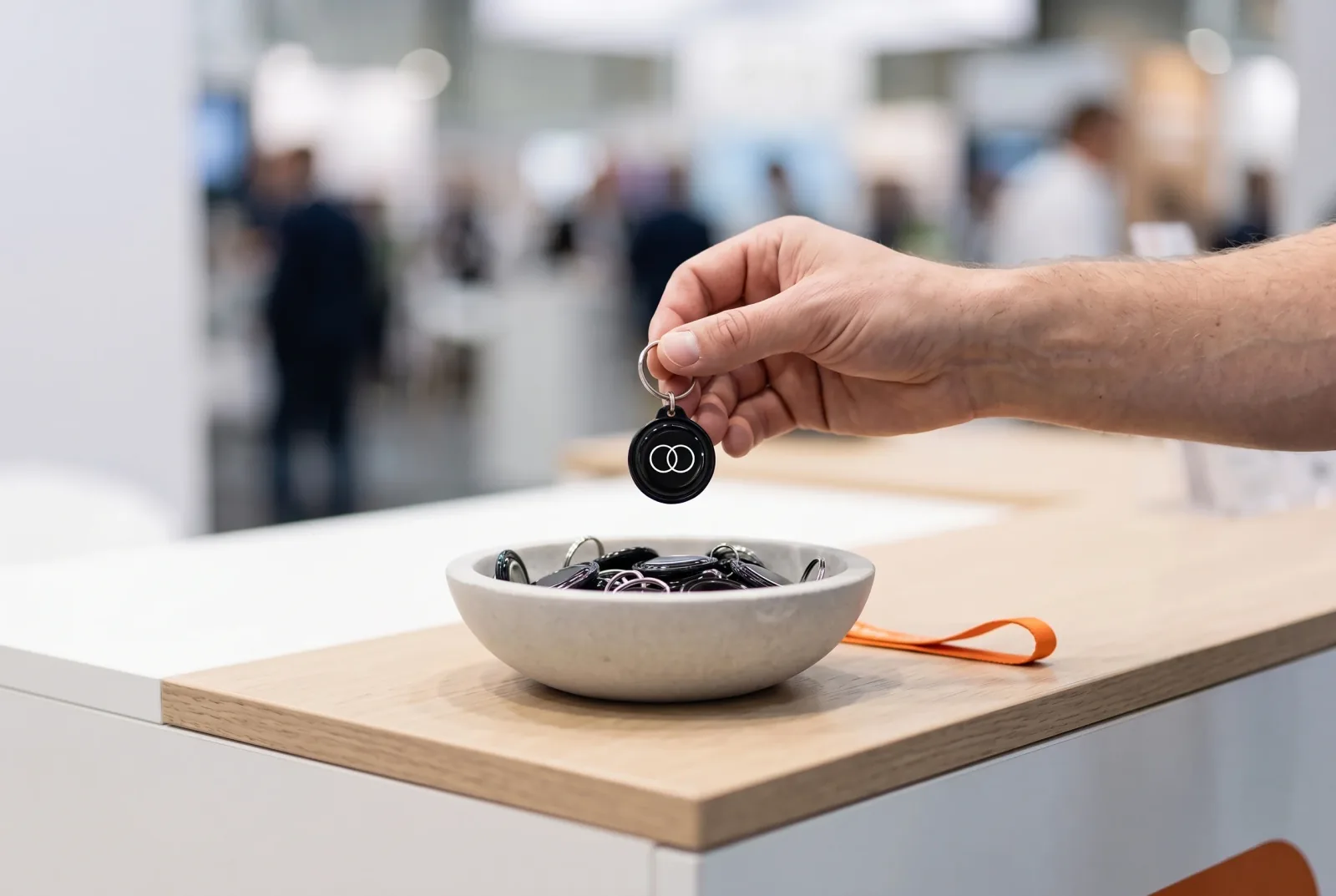
It looks different when the promotional item has an activation moment — the recipient puts it into use once, say to register loss protection to their name, and visibly passes through your campaign in the process. (How these mechanics work in detail and where their limits lie is in the article “From Give-away to Lead”.) From that moment on, the arithmetic is simple — provided you do it honestly.
A sample calculation with open assumptions, not a promise: suppose you replace 2,000 scatter items at €2.50 with 500 high-quality, activatable promotional items at €10 — the same budget of €5,000, handed over deliberately instead of laid out. If only one in ten recipients activates, there are 50 contacts in the dashboard: €100 per contact. If one in four activates, it’s 125 contacts: €40 per contact. Which rate you reach depends on occasion, item and target group — which is why a serious calculation includes both scenarios, not the prettier of the two figures.
A worked example with an open assumption is on the BrandID pricing, ready for your own numbers.
What’s decisive is the benchmark: set this range next to what your own marketing dashboard shows for search and social ads in your industry. In many B2B segments, the promotional-item calculation has nothing to hide in this comparison — especially since the zero provable contacts of the scatter-item status quo are the real loser of the table.
Not every lead is equal — calculate one step further
Whoever only compares the price per contact systematically underestimates the trade-show contact. A click lead is often a curious browser with a throwaway address; an activated promotional-item contact had a conversation at the stand, holds a useful object of your brand in their hands and deliberately signed up. The fair comparison therefore doesn’t end at the cost-per-lead, but one step later: how many of these contacts respond, book an appointment, become customers? Only there does it become clear what the contact moment at the stand was worth.
And one more piece of honesty belongs in the arithmetic: The method stands or falls with the item. A give-away with no use of its own won’t get activated even with a return channel — why would it. Only the combination of an object you want to keep and an activation moment that serves the recipient themselves turns the trade-show budget into a line in the reporting rather than a blank.
The good news to finish: you don’t have to believe anything for it. A pilot batch, two scenarios, one trade-show date — after that you have your own figure for the first time. And that beats any study statistic.
FAQ
What activation rate can I assume for the calculation?
There's no reputable blanket figure — the rate depends on the occasion (a personal conversation or a bargain bin?), the item's practical value and the target group. So work with scenarios instead of a single number: what does a contact cost if one in ten activates? What if it's one in four? If even the pessimistic scenario is within the range of your other channels, the decision is robust.
Is a lead from a promotional item even comparable to an advertising lead?
Only to a limited extent — and that argues rather in favour of the promotional item: the contact arises after a personal conversation and a deliberate activation, not after an incidental click. So don't just compare the price per lead, but also what happens after the lead: response rates, appointment rates, closings.
Does the arithmetic work outside of trade shows too?
Yes — anywhere promotional items are handed over: at contract signing by field sales, in the onboarding pack for new employees, as a year-end client gift. The mechanics (quantity → activations → contacts) stay the same, only the scenario assumptions shift with the occasion.