



01 Service company
Lift and installation service
Complete, assigned reports instead of follow-up questions, and a visible digital reporting route on every installation you look after.
Personal advice · reply within 24 h
Sold out · back soon
ServiceID · Lifts & building services
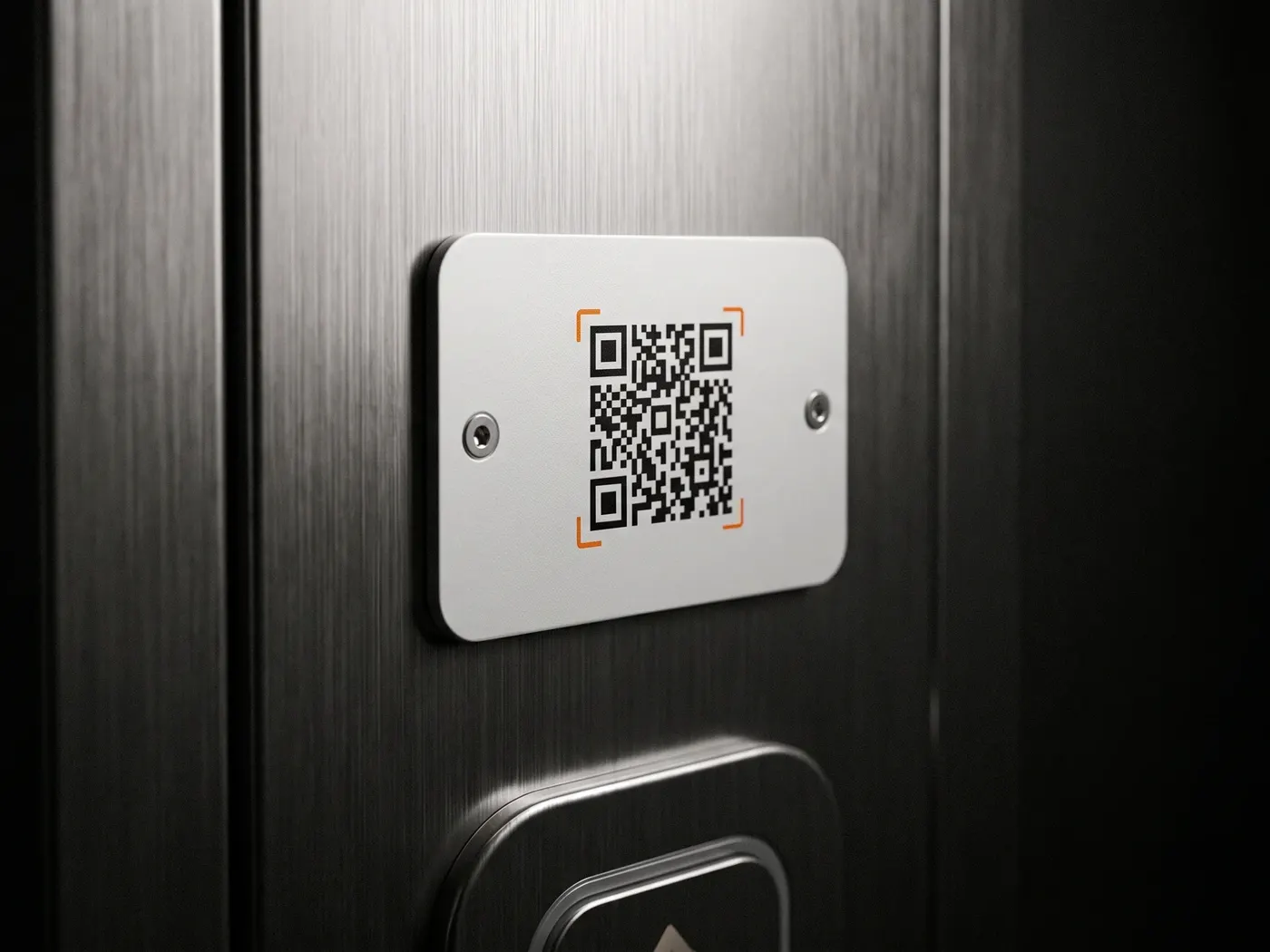
The lift door sticks, the corridor lighting flickers, there's water in the plant room. Whoever notices is standing right in front of it, but has no number and no installation ID. A report point on the installation turns this into a complete report to your service company, with installation and location.
The boundary
For emergencies involving people in a lift, an emergency call system in the car is required, with a direct voice connection to a permanently staffed centre. ServiceID does not replace this emergency call system. Anyone who is trapped presses the emergency button.
ServiceID is built for everything before and around it: the sticking door, the unusual noise, the broken lighting, the water stain in the plant room. These are reports nobody phones in today, but they decide whether an irregularity turns into a breakdown.
Who it's for
01 Service company
Complete, assigned reports instead of follow-up questions, and a visible digital reporting route on every installation you look after.
02 Management
Tenants report right at the installation. If you wish, the management office receives a copy of every report.
03 Building services
Even without a lift, every technical installation in the building can be made reportable, with its own topics and recipients.
Prices & process
One price per installation, a one-time setup, no minimum term.
Questions & answers
No, explicitly not. The emergency call system in the car is required for emergencies involving people and remains untouched. ServiceID is the reporting route for faults and irregularities around the installation.
Complete reports instead of follow-up questions: installation, location, topic, photo and timestamp come with every report, so the technician knows what to expect before setting off. Plus reporting on which installations report most often.
Yes. You define recipients and topics per installation or property group. Reports from property A can go to a different team than those from property B, and the management office can be copied in.
Yes. The report points are weatherproof and UV-resistant. If one gets damaged, it can be blocked and replaced individually.
As soon as topics and recipients are settled, we produce your report points. It usually takes about two weeks from order to first report, and the fitting itself takes an afternoon.
ServiceID for lifts & building services
Briefly describe your portfolio, whether you are a service company, a property manager or a facility services provider. In the intro call we show you a suitable setup, and then you receive a quote.
Abdou Seye
Co-Founder & CSO · Business
You speak directly with us, the people who built the system.
30-minute call · free & no obligation
Briefly describe your project · reply within 24 h on business days
A confirmation is on its way to — check your spam folder just in case. We usually get back to you within one business day.
That didn't go through just now. Send us your request directly by email instead — your details are already filled in:
Send by emailPrivacy
You know the drill: we see what you like here and which ads land — and you see less nonsense in return. Essentials run anyway. Details: privacy policy.