



← Klartext Business
Client Gifts That Last: An Honest Selection Guide
11 Jun 2026 SilentLink-Team ≈ 3 min read
Key points
- The hardest test for a client gift is the would-you-miss-it test: would the recipient miss it if it were gone? Wine and sweets never pass it (they get used up), décor almost never — objects with a daily function pass it.
- A gift only works where everyday life happens: on the keyring, on the suitcase, on the desk. Whoever occupies one of these spots permanently is present without being intrusive.
- The underestimated factor is lead time: personalised gifts of good quality take weeks, not days — if you want to give at year's end, you're better off deciding in September than in November.
You can measure the success of a client gift by a single date: 15 January. The wine has been drunk, the biscuits eaten, the calendar is on the wall — maybe. Of most gifts sent out in December with good intentions, by mid-January nothing is left but the memory of a nice gesture. That’s not nothing. But for a budget that has to be defended anew every year, “a nice gesture” is a thin result.
Yet choosing a good gift isn’t a matter of taste, but a matter of criteria. Three questions are enough.
First: does it pass the would-you-miss-it test?
The most honest test question for any client gift is: Would the recipient miss it if it were gone tomorrow? Consumable gifts fail here by design — they’re meant to disappear, after all. Decorative items almost always fail: the third bottle opener, the fifth mug and the yearly calendar compete with things the recipient already owns.
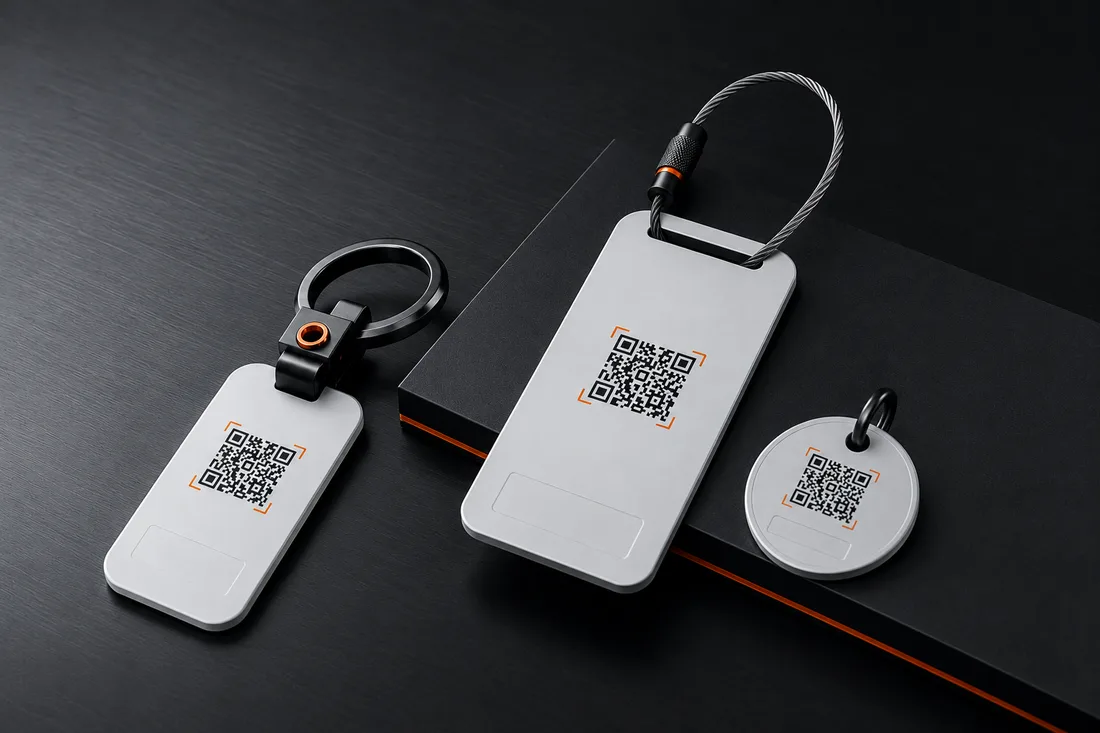
What passes the test are objects with a function that’s actually needed in everyday life — and ideally one that covers a real risk. Loss protection on a keyring is the textbook example: the keyring is the object whose loss really hurts (a locksmith, new locks, a lost day), and the gift is right there at exactly that moment. Something like that doesn’t end up in a drawer, because it works.
Second: where in daily life does it live?
The second question is almost never asked, even though it determines the entire duration of the effect: Which place in the recipient’s life does the gift occupy? There are only a handful of places where an object is seen and used every day — the keyring, the suitcase and the bag, the desk, the wallet. Whoever occupies one of these places is present for years without ever being intrusive; the industry figures on the long-term use of promotional items (we put them in context here) are reached by exactly those items that have found such a place.
From this also follows the right order of decisions: first the place, then the object, and the logo last. A mediocre object with a big logo loses to a good object with a discreet one — because the logo is only seen as often as the object is used.
Third: does the quality say what you want to say?
A gift is a material sample of your brand. The recipient infers — unconsciously, but reliably — the care of the sender from the feel of the gift. Cheap plastic with a logo says something no greeting card can take back. That’s not an argument for luxury, but for a simple rule: fewer recipients, but an object that feels like the brand you want to be. Especially since the tax framework (a €50 threshold per recipient per year for the operating-expense deduction — details belong with your tax adviser) leaves plenty of room for quality.
The factor almost everyone underestimates: lead time
And then there’s the calendar. Good client gifts fail less often on the idea than on the timing of the decision: personalised production of decent quality takes weeks — with our BrandID production, three to six of them lie between print approval and delivery, and before print approval come your internal sign-offs. Whoever only starts on the year-end gift in November no longer chooses from what’s good, but from what’s still possible.
The rule of thumb is uncomfortable but simple: The December gift is decided in September. The consolation: a gift that passes the would-you-miss-it test, occupies an everyday place and feels good doesn’t have to be reinvented every year. It stays, after all — and that was exactly the plan.
FAQ
How much may a client gift cost for tax purposes?
In Germany, a threshold of €50 per recipient per year applies to the deduction of gifts to business partners as operating expenses (raised as of 2024; previously €35). How it applies in an individual case — for instance regarding VAT or flat-rate taxation — is something you should clarify with your tax adviser; this article is not tax advice.
Isn't a logo on the gift intrusive?
On an object with no use, the logo comes across as advertising — because the object is nothing else. On an object that serves the recipient every day, the same brand becomes the sender of a useful thing. So what's decisive is less the size of the logo than the question of whether the object would be kept even without the logo.
How much lead time do I need for personalised gifts at year's end?
Count backwards: with custom-made promotional items, there are typically several weeks between print approval and delivery — with our BrandID production, three to six. On top of that come your internal sign-off on artwork and quantity, plus shipping to the recipients. Whoever decides in September gives in December without the rush; whoever starts in November chooses from what's still available.