

← Klartext Guide
QR Contact Tag for Your Car: 7 Things to Check Before You Buy
13 Jun 2026 SilentLink-Team ≈ 4 min read
Key points
- A good QR contact tag makes you reachable without giving away your phone number: the message runs anonymously through a relay, instead of sitting in plain text on your car.
- The decisive buying criteria: anonymous relaying, no forced app for the finder, GDPR-compliant servers in Germany/the EU, transferability when you sell the car, and an honest pricing model with no subscription trap.
- With the plan, what counts is what's already included for free – a WhatsApp notification on the free plan is not a given.
- Weatherproof material and secure mounting decide whether the tag survives everyday life on the vehicle.
A parking bump in the supermarket car park, the lights left on after a long drive, the delivery van double-parked and blocking someone in: there are many moments when a stranger would need to reach you briefly — without you wanting to leave your mobile number behind the windscreen for it. That’s exactly what QR contact tags for cars are for. But the offerings differ more than a first glance suggests. These seven points separate a well-thought-out contact point from a data leak.
Does your phone number really stay hidden?
This is the most important question — and the point where good and bad solutions part ways. Look at what is actually disclosed when someone gets in touch. An engraved tag with a number, or a note behind the windscreen, publishes your data to everyone who walks past. A well-thought-out solution does the opposite: the tag only carries a random, anonymous code that leads to a short form. The finder writes, the message is relayed anonymously — and your number stays where it belongs: with you. Rule of thumb: if there’s a phone number on the product, it isn’t a privacy product.
Does it work without an app — for you and the finder?
The most helpful stranger is no use to you if they first have to install an app to message you. Every extra hurdle costs you contact rate. So make sure the code can be scanned with the perfectly ordinary smartphone camera and opens a web page directly — no download, no registration, no account. This applies to both sides: you too should receive your notifications without being tied to a particular app.
Which notification channels are included — and from when does it cost?
Being notified by email, SMS or WhatsApp sounds like a standard — but it isn’t, on every plan. What’s decisive is less which channels a provider offers at all, and more which ones are already included on the free plan. A WhatsApp notification is far from being part of the free package everywhere; with many solutions it’s only unlocked in the paid subscription. At SilentLink, the WhatsApp notification is already included in the permanently free Starter plan — a detail that makes the difference in everyday life, because most people see a message there fastest.
Where are the servers — and is it GDPR-compliant?
For a product whose entire purpose is protecting your data, the data processing can’t be a blind spot. Ask specifically: where are the servers, and under which law is data processed? Servers in Germany or the EU and demonstrably GDPR-compliant processing are the minimum. “Made in Germany” here is not just a seal of quality, but a statement about the legal space your data sits in — and about the set of people who are allowed to access it if it comes to that.
What happens when you sell or lose the car?
A car rarely stays the same for a lifetime. A good solution takes that into account: you should be able to block the code yourself at any time or transfer the reachability to a new vehicle. When selling, this is essential — from the moment it’s blocked, the old code must lead nowhere, so the new owner can’t reach you unintentionally. So check whether you have full control in the dashboard: pause, block, transfer. Anyone who doesn’t offer that is selling you a dead piece of plastic, not a service.
QR code or NFC — and does the tag hold up on the vehicle?
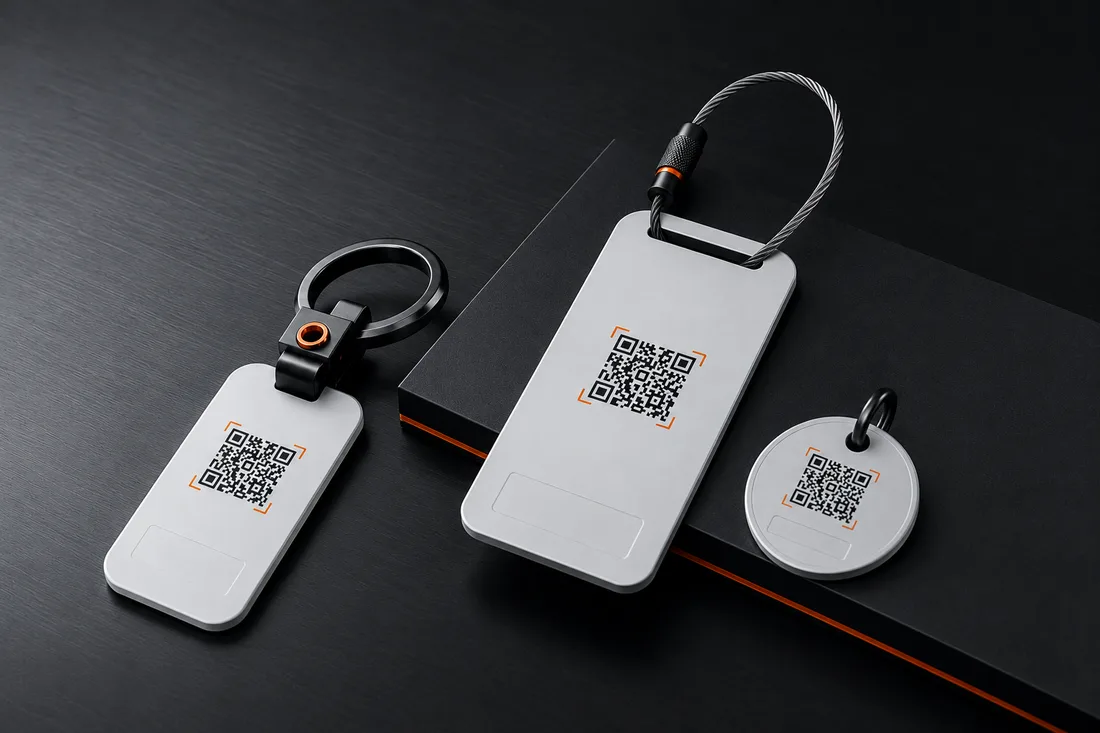
Technically there are two routes: the optical QR code, which works with any camera, and NFC, which triggers contact with a tap. The most robust is the combination — QR as the universal standard, NFC as the comfort option. At least as important is the physics: a tag on a car is exposed to sun, rain, frost and the car wash. Look for UV-resistant, weatherproof material and a mounting that holds without damaging the paint. A QR code that’s faded and unreadable after one summer helps no one at the crucial moment.
What does it really cost — one-off or subscription trap?
Finally, the fine print. Reputable providers state a clear one-off price for the product and make additional plans optional. You should prick up your ears if the actual benefit only becomes chargeable after a “free phase”, or the tag doesn’t work at all without an ongoing subscription. Ask yourself: does the basic function stay free permanently? Are the prices transparent before you buy? And are scarcity or discount claims based on real facts? A product that does without dark patterns has no need to railroad you.
In short
You recognise a good QR contact tag for your car not by the loudest promise, but by what it leaves out: no number on the product, no app for the finder, no data outside the EU, no hidden costs. If these seven points check out, you get exactly what it’s really about — being reachable when it counts, without giving up your privacy for it.
FAQ
Will a stranger see my mobile number if I use a QR code on my car?
With a well-thought-out solution, no. The tag only carries an anonymous code that leads to a small contact form. The finder writes you a message that is relayed anonymously – they never get to see your phone number, your name or your email. It's only different if the number is printed directly on the tag or placed behind the windscreen: then it's public.
Is a QR code with a contact function on a car GDPR-compliant?
That depends on the provider. Make sure the data is processed on servers in Germany or the EU and that your contact details aren't passed on to the finder, but only used to deliver the message. It's exactly this separation – being reachable without disclosing data – that is the core of a GDPR-compliant solution.
Does the finder need an app to scan the code?
With a good solution, no. The code can be scanned with the ordinary smartphone camera and opens a web page with a short form directly – no download, no account. Every app hurdle lowers the chance that a helpful finder actually sends the message.
What happens to the QR tag when I sell my car?
With a reputable provider you stay in control: you can permanently block the code in the dashboard or transfer the reachability to a new vehicle. What matters is that the old code leads nowhere after the sale – the buyer shouldn't be able to reach you unintentionally.
What does a QR contact tag for a car cost?
A one-off purchase price of around €25 is typical. What's decisive is the fine print: does the basic function stay free permanently, or does a subscription kick in after a free phase? A fair model states a clear one-off price and makes additional plans optional rather than mandatory.